|
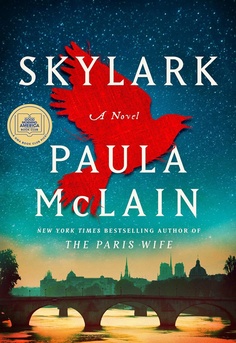
Skylark |
by Paula McLain |
 |
Book Summary |
A GOOD MORNING AMERICA BOOK CLUB PICK! The New York Times bestselling author of The Paris Wife weaves a mesmerizing tale of Paris above and below-where a woman's quest for artistic freedom in 1664 intertwines with a doctor's dangerous mission during the German occupation in the 1940s, revealing a story of courage and resistance that transcends time. 1664: Alouette Voland is the daughter of a master dyer at the famed Gobelin Tapestry Works, who secretly dreams of escaping her circumstances and creating her own masterpiece. When her father is unjustly imprisoned, Alouette's efforts to save him lead to her own confinement in the notorious Salpetriere asylum, where thousands of women are held captive and cruelly treated. But within its grim walls, she discovers a small group of brave allies, and the possibility of a life bigger than she ever imagined. 1939: Kristof Larson is a medical student beginning his psychiatric residency in Paris, whose neighbors on the Rue de Gobelins are a Jewish family who have fled Poland. When Nazi forces descend on the city, Kristof becomes their only hope for survival, even as his work as a doctor is jeopardized. A spellbinding and transportive look at a side of Paris known to very few-the underground city that is a mirror reflection of the glories above-Paula McLain's unforgettable new novel chronicles two parallel journeys of defiance and rescue that connect in ways both surprising and deeply moving. From the publisher Simon & Schuster / Atria Books | Jan 6, 2026 | 464 pages | ISBN:9781668028155 | Literary Historical Fiction Also by Paula McLain: The Paris Wife
|
Discussion Questions |
1. Skylark was inspired by the real-life network of tunnels under Paris. Were you at all familiar with these and their
history prior to reading the novel? What did you discover that surprised you about the history of Paris while reading
Skylark?
2. At the start of the novel, Alouette and her father's lives revolve entirely around the world of fabric dye. She says that colors from "legendary crimsons, impossible indigos" to "Tyrian purple" occupy every free space in their lives, and bleed into the occupied ones. What does their obsession reveal about their characters and about the society in which they live? What did you make of the fact that the right to wear certain colors was reserved for people of high social rank? Today, what do we infer about people from the type of colors or clothes they choose to wear? 3. Why do you think Paula McLain decided to interweave dual narratives to create this story? What do Kristof and Sasha's narratives in World War II have in common with the stories of Alouette and the women confined in Salpetriere in 1664, and vice versa? 4. When Alouette is walking in the orchard at Salpetriere, she encounters the superioress tending a small, twisted sapling. She tells Alouette, "Everything worth keeping must be tended. Sometimes at all costs." What do you think the superioress is trying to convey to Alouette? Did her actions in the orchard change the way you thought of her? 5. When Alesander shows Kristof the tunnels for the first time, he tells Kristof that his grandfather used to say that every city has an aboveground face and a belowground face that only few remember. Have you ever experienced a city this way? If so, what did the belowground reveal that the above did not? 6. When we first meet Alouette, she feels disdain for the meaning of her name: Skylark . As she endures increasing hardship at Salpetriere, do you think her perception of her name changes? Can you pinpoint any particular moments when she embraces her namesake? 7. Alouette's connection to Etienne sparks just as she prepares to flee from her life in Saint-Marcel. Sasha and Gerard find one another just as anti-Semitisim overtakes Paris. Love seems to find the main characters during particularly tumultuous or perhaps inopportune times. What are some of the challenges of these relationships, and what are some of the benefits? 8. The impact of an individual person's bravery is an important theme throughout the novel. Though none of the characters in Skylark are responsible for the circumstances of the world in which they find themselves, they still muster the courage to save themselves, and more importantly, to try to save those around them. Did you understand why characters like Alouette and Alesander were driven to action? What does that say about resistance and why some engage in it while others do not? 9. Paris could be considered its own character in the book, from the descriptions of the Bievre to the Seine, the rue des Gobelins, and, of course, the tunnels and catacombs. What stood out the most to you about Paris in these time periods? Did anything about the differences and similarities between the 1600s and the 1900s surprise you? 10. The treatment of psychological illness, though it would not have been known as such in Alouette's time, is one of the many threads connecting the two time periods of the book. Discuss the parallels between the horrors at Salpetriere and the tragic fates of Kristof's patients at the hands of the Nazis. In what ways has our understanding of mental illness changed since the 1940s? 11. At the end of the novel, we learn about the book of colors that Alouette has collected, a catalog of the knowledge she and the women in her community in Brittany possess. How did this resolution of Alouette's identity make you feel? What did it reveal about the multifaceted nature of dyeing and about women's work more generally? 12. While Alouette's story ends definitively, Sasha and Kristof's stories do not. How do you imagine their stories might continue after the end of the book? Discussion Questions by the Publisher Book Club Talking Points:
Skylark is not plot-heavy, but it gives you so much to talk about-marriage, ambition, compromise, and what it means to grow alongside (or apart from) someone you love. The characters feel real, the choices feel messy and honest, and everyone in a book club will come away with a slightly different take on who's "right," who's "wrong," and whether that even matters. It' sure to spark thoughtful, personal conversations.  |
Praise |
"[A] vivid, inspirational story of brave resilience." -People "Paula McLain returns to Paris, the setting of her most celebrated novel, to intertwine two eras of upheaval with masterful precision. Seductive, subversive, and impossible to put down, Skylark shines a light into the darkest corners of history, revealing the enduring strength of the human spirit." -Christina Baker Kline, #1 New York Times bestselling author of Orphan Train "Above all, Skylark is the gift of a brilliant storyteller... If she were not a superb novelist, McLain most surely would be a painter-what brilliant colors, images, and textures. Toward the end, I was holding my breath-the stunning ending will resonate long after the book is closed." -Frances Mayes, #1 New York Times bestselling author of Under the Tuscan Sun "An enthralling plunge into deep layers of Paris history, both beautifully written and breathtakingly suspenseful. I could not put it down." -Helen Simonson, New York Times bestselling author of Major Pettigrew's Last Stand "From its very first moment, Skylark held me so close it felt like we shared a heartbeat. Intimate and sweeping, this novel celebrates the rare kind of bravery that resounds for centuries through the streets of our beloved cities and in our bleakest times of war and fear. I'm convinced no one in the world can write like Paula McLain. Vital and prescient, she is absolutely one of the finest writers of our age." -Amy Jo Burns, author of Mercury "Readers will be enthralled by McLain's vivid storytelling, engaged with her memorable cast of characters, and enraged at the cruelties humans have exacted on one another throughout history." -Library Journal (starred review) "McLain expertly juxtaposes the courageous actions of both Alouette and Kristof as they seek freedom for themselves and others and embrace the challenges and dangers of the subterranean maze. Fans of stirring historicals won't want to miss this." -Publishers Weekly "A resounding elegy of love, courage, and defiance. Paula McLain melds two timelines and one city into the kind of story you think about long after you've finished reading. Mysterious and haunting and timeless. I loved it." -Ariel Lawhon, New York Times bestselling author of The Frozen River "A magnificent book with prose that is lush, seductive, and velvet-rich. This big, bold, deep, satisfying literary adventure is a stunning tour-de-force." -Adrienne Brodeur, bestselling author of Wild Game "With fine-tuned historical detail, McLain's latest is a compelling tale of human will, resilience, and connection." -Booklist "Paula McLain is a story alchemist. In Skylark, she saturates our imaginations with the colorful threads of two distinct timelines. Artfully crafted and poetically rendered, this is the kind of historical fiction I live for-stories where the past acts as a mirror for the modern milieu." -Sarah McCoy, New York Times bestselling author of Whatever Happened to Lori Lovely? |
 |
Explore 4+ years of curated picks that actually spark a conversation.
|
More Must-Read Books |
 Daughters of the Sun and Moon By Lisa See
Beloved New York Times bestselling author Lisa See draws on the vibrancy and turmoil of post-Civil War Los Angeles to tell the story of three Chinese women who managed to survive and, eventually, thrive, despite all odds. ...More
|
 The Book Witch By Meg Shaffer She can hop into any novel, she just can't stay there. Come along with the book witch in this magical and inspiring love letter to reading from the USA Today bestselling author of The Wishing Game ... More
|
 Keeper of Lost Children By Sadeqa Johnson
In this new novel from the New York Times bestselling author of The House of Eve, one American woman's vision in post WWII Germany will tie together three people in an unexpected way....More
|
 My Husband's Wife By Alice Feeney The New York Times bestselling Queen of Twists is back with a psychological masterpiece that will leave you questioning everything you know about love, identity, and revenge. By the author of His & Hers, now a #1 Netflix show!... More
|
You May Also Like: |


|
Visit Our Blog |
 |
Most Antipipated Books of 2026 ..... Our Favorites.
|
|
|